Hi!
Coming back to my blog after a few days of crazy work to be with you always feels so good! Today is a rainy afternoon here in Miami and I was finishing the instructions for this new tutorial with my new line
Carnaby St. to cheer me up with its bright colors. For those of you having wintery and rainy days, I hope it cheers you up too... and if you are enjoying summertime on another corner of the world I guess it is always good to be making a new tutorial as well :)
MATERIALS (to make three coasters)
For this project, I used a combination of
Pure Elements solids from Art Gallery Fabrics and some prints from my newest collection
Carnaby Street. You will need:
FABRICS:
One (1) Fat Eighth of the following:
- CST-3102 Psychedelia Gold
- CST-3200 Brit Boutique Radiant
- CST-3204 Girl About Town Rose
- PE-405 Cherry Lipgloss
- PE-424 Mirage Blue
½ yd of PE-408 White Linen
Three (3) 11" square sheets of non-fusible batting
Coaster Trapezoid Template
NOTIONS:
- Ruler with 60° angle guides
- Rotary Cutter
- Water Soluble marker
INSTRUCTIONS (for coaster with a White Linen border)
Sew all right sides together with ¼" seam allowance. Press open.
Cut the following:
- Cut two (2) of each of the trapezoids in the template from PE-405 and PE-424
- Cut CST-3102, CST-3200 and CST-3204 into 1 7/8" x WOF strips
- Cut three (3) 11" squares from PE-408
- Cut two (2) of each of the trapezoids in the template from PE-408
- Cut three (3) 1 3/4" x WOF strips from PE-408
Step 1. Grouping the strips
Make one group (A) that contains two CST-3102 strips and one CST-3200 strip. Make another group (B) that has one CST-3204 strip, one CST-3102 strip, and one CST-3200 strip.
Step 2. Sewing the strips together
Once you have those two groups, piece the strips in order listed above. Place the fabrics RIGHT sides facing together and sew.
Press all seams open.
Step 3. Cutting the strips
Once you have these long strips pieced, grad a ruler with a 60° mark and cut strips that measure 1 7/8" in width. To do this, you will cut the left corner of the fabric at a 60° angle with the slant ascending from left to right. Once that cut is done, you can proceed to use the ruler to make parallel cuts to create 1 7/8" strips.
Cut six of these strips from Group A and 3 of these strips from Group B.
Step 4. Piecing together the strips
Make three groups of the new angled strips that contain two strips from Group A and one strip from group B.
You will sew those strips together in order A-B-A, making sure the seams match. In order to do this, you will grab the first and second strip and place them RIGHT sides facing together, positioning them so that the first place that the needle in the machine hits is the exact ¼" intersection of both fabrics.
Once done sewing, you will add the third strip, repeating the previous step.
Press seams open.
When you are done, you should have a rhombus/diamond shape like this one below...
Step 5. Attaching the borders
For the borders, I have chosen a different color for each coaster. I will show how to construct the coaster that has the White Linen borders. For the other two coasters, simply use the trapezoid templates with the Cherry Lipgloss (PE-405) and Mirage Blue (PE-424).
Grab the diamond and all of the pieces of the White Linen (PE-408) fabric that you cut with the template.
First, you will attach the smaller template pieces on opposite sides of the rhombus: the top right and the bottom left sides.
To attach these, simply align them tip to tip (RIGHT sides facing together) and sew.
Press seams open.
For the longer template pieces, you will use the same technique used to piece the
angled strips. Align both pieces (RIGHT sides facing together) so that
they intersect at ¼" and put your needle down exactly at this point.
Sew. When you are done, you should have a piece that looks like a hexagon!
Step 6. Quilting the top
Now you're ready to quilt! Grab the 11" square of White Linen and place the 11" square sheet of batting on top. Grab your newly constructed hexagon and put it on top of the batting, making sure it is centered.
Using a water soluble pen, draw lines parallel to the edge that are 1" apart from each other. Pin the three layers in place and quilt on top of the lines.
Now draw lines perpendicular to the first lines 1" apart from each other, pin, and quilt.
When you are finished, use a rotary cutter to trim off the excess batting and backing fabric. Damp your coaster to remove the guidelines Press.
Step 6. Binding your coasters
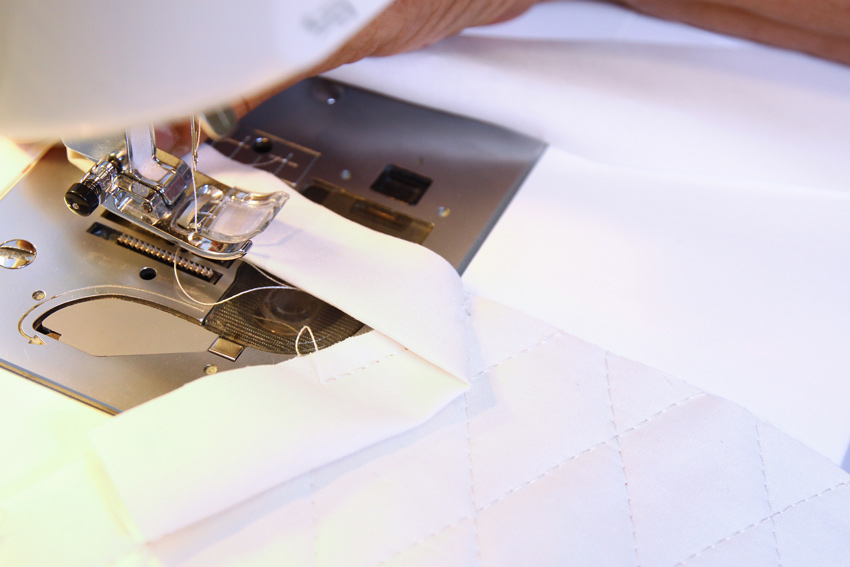
For this step, I did a double binding to create stability. Grab 1 3/4" x WOF strip of White Linen. Fold it in half, lengthwise, and start sewing it in the middle of one of the sides of the coaster on the back, aligning the strip's raw edges with the coaster's raw edges. Leave an approximated 3" tail.
Stop stitching ¼" before the next edge of the coaster. Clip the threads. Remove the coaster from under the machine presser foot. Fold the strip in a motion of 45° and upward, pressing with your fingers.
Hold this fold with your finger, bringing the strip down in line with the next edge, making a horizontal fold that aligns with the top edge of the coaster.
Start sewing at ¼" of the border, stitching all the layers. Do the same in the six corners of each coaster.
Stop stitching before you reach the last 2 to 3 inches. Cut the threads and remove the coaster from under the machine presser foot. Lay those loose ends of the binding flat along the coaster edge, folding the ends back on themselves where they meet. Press them together to form a crease. Using this crease as the stitching line, sew the two open ends of the binding with RIGHT sides facing together (you can help yourself marking with a pencil if the crease is difficult to see).
Trim the seam to ¼" and press open.
Complete the sewing.
Turn the binding to the front of the coaster, stitching all around 1/16" from the folded edge. This stitch will secure the binding and it will create a decorative top-stitch.
When you get to each corner, cross-fold the fabric, stop right at the intersection, pivot, and continue sewing.
I hope you enjoyed the tutorial :) You can make a few to renew your outdoor patio decoration this coming spring, or to give them as gifts to your friends for their own decoration...
I had so much fun... now is your turn!
Much love, Pat